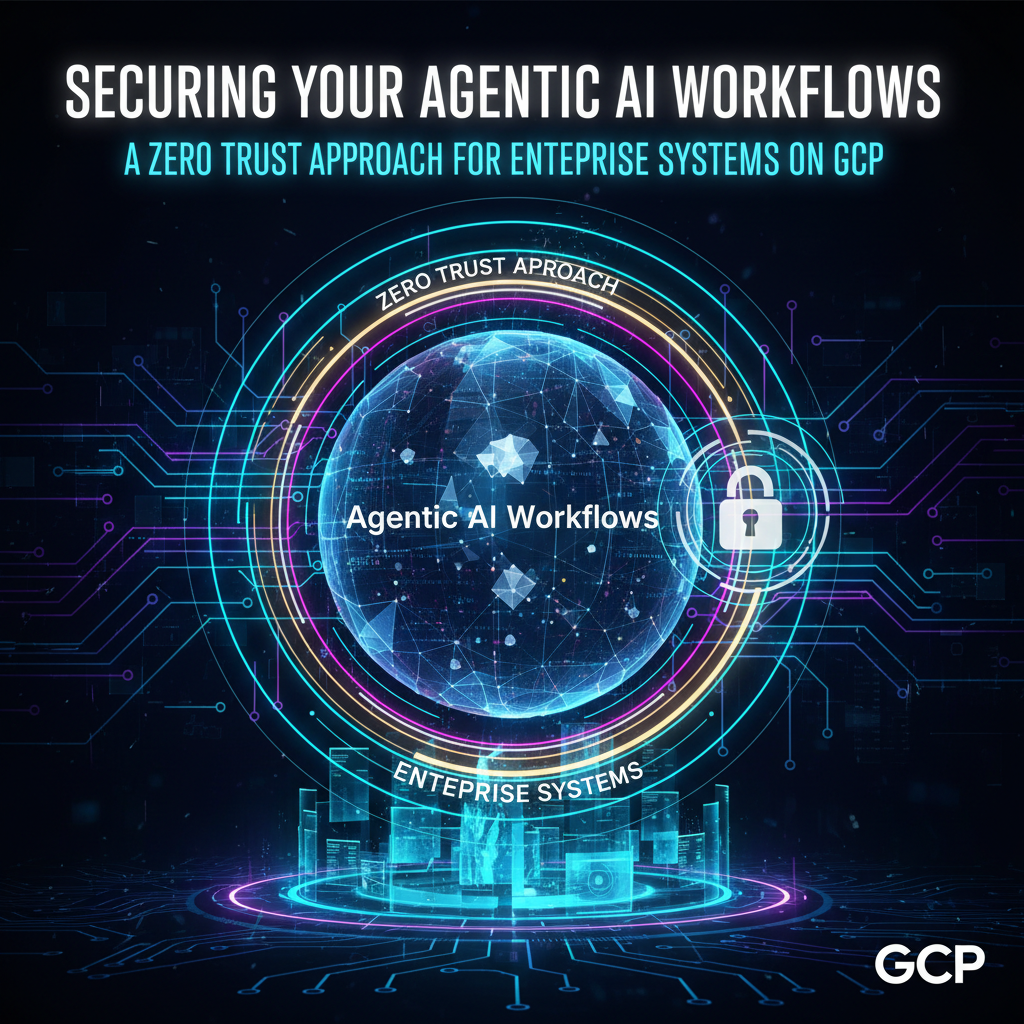
Securing Your Agentic AI Workflows: A Zero Trust Approach for Enterprise Systems on GCP
Agentic AI offers immense potential for enterprise automation, but also presents significant security challenges. Traditional security models fall short for these dynamic systems. Discover how a Zero Trust approach can effectively secure your agentic AI workflows on Google Cloud Platform.

I. Introduction: The Rise of Agentic AI and the Imperative for Trust
Imagine intelligent AI agents autonomously executing critical tasks within your enterprise – optimizing supply chains, detecting fraud, or even managing IT infrastructure. This isn't science fiction; it's the near future with Agentic AI. But with great power comes great responsibility, and security is paramount.
At its core, Agentic AI refers to AI systems designed to perceive, reason, plan, and act autonomously or semi-autonomously to achieve defined goals within an enterprise context. Unlike traditional AI models that primarily perform pattern recognition or prediction, agentic systems can independently orchestrate complex workflows, interact with various other systems, and adapt their actions based on real-time feedback. Think of them as digital employees capable of making decisions and executing tasks with minimal human oversight.
This leap in AI capabilities brings unprecedented efficiency and innovation, but it also introduces profound security challenges. Why? Traditional security paradigms, often built around static perimeters and implicit trust within the network, simply fall short for these dynamic, self-orchestrating systems. An agent, for instance, might access different data sources, communicate with various APIs, and make decisions impacting critical business operations. A single compromise – whether due to malicious intent or an unforeseen vulnerability – could have cascading effects throughout your enterprise, leading to data breaches, operational disruptions, or financial losses.
This is where Zero Trust emerges as the indispensable philosophical and architectural answer. Originating from the principle of "never trust, always verify," Zero Trust mandates that no user, device, application, or system (including your sophisticated AI agents) is inherently trusted, regardless of its location relative to your network perimeter. Every single interaction within your enterprise, especially involving autonomous AI agents, must be explicitly authenticated, authorized, and continuously monitored.
Google Cloud, with its inherently secure-by-design infrastructure and an extensive suite of security services, is uniquely positioned to enable a robust Zero Trust posture for these advanced Agentic AI systems. Its global network, granular access controls (via IAM), and integrated security intelligence (via products like Security Command Center) provide the foundational layers necessary to manage the complexity and mitigate the risks associated with autonomous agents.
In this blog post, WALT Labs will guide you through understanding the distinctive security risks associated with Agentic AI, show you how to apply fundamental Zero Trust principles to these workflows, and demonstrate how to leverage specific Google Cloud platform tools to build a resilient and secure environment for your intelligent agents. Prepare to build a foundation of explicit trust for your future AI innovations.
II. Understanding the Landscape: Security Risks in Agentic AI Workflows
The introduction of Agentic AI dramatically expands the enterprise attack surface. Unlike a singular monolithic application, agentic workflows are inherently distributed, interconnected, and dynamic. This complexity introduces a new class of vulnerabilities that require a fresh security perspective.
The Expanded Attack Surface:
Agentic AI systems often comprise multiple interacting agents, external data sources, third-party APIs, and dynamic execution environments. Each interaction point and component represents a potential entry for attackers.
- Agent Impersonation/Tampering: Imagine a sophisticated agent responsible for approving financial transactions. If its identity is compromised – perhaps its service account keys are stolen, or its runtime environment is infiltrated – a malicious actor could impersonate the agent, perform unauthorized actions, or alter its decision-making logic to achieve illicit gains.
- Data Poisoning: Agents learn and make decisions based on the data they consume. Maliciously injected or manipulated data can "poison" an agent's understanding, leading to biased outputs, incorrect decisions, or even systems failures. For example, a supply chain optimization agent fed with manipulated inventory data could cause significant disruptions.
- Supply Chain Attacks (for AI Components): Just like software, AI models and machine learning frameworks rely on a vast ecosystem of libraries, pre-trained models, and development tools. Vulnerabilities or backdoors introduced within these external components can be inherited by your agents, creating a stealthy entry point for attackers to exploit.
- Unauthorized Access to AI Resources: Agentic AI often requires significant computational power (e.g., GPU clusters for model inference, specialized AI accelerators). Compromise of the underlying infrastructure – be it on Compute Engine, GKE, or a managed AI service – allows attackers to not only disrupt operations but also steal valuable models, data, or even use your resources for nefarious purposes like cryptocurrency mining.
- Prompt Injection/Evasion: For agents that interact with or process natural language, prompt injection involves crafting inputs that hijack the agent's intended instruction set, causing it to perform actions outside its programmed scope or reveal sensitive internal information. Conversely, prompt evasion involves crafting inputs that bypass an agent's safety filters, allowing it to generate harmful or undesirable content.
- Lateral Movement: An exploited agent isn't necessarily the end goal for an attacker. Due to its inherent connectivity to various enterprise systems (databases, CRMs, internal APIs), a compromised agent can serve as a highly effective beachhead for an attacker to move laterally across your network, escalating privileges and accessing more critical assets.
The Interconnected Nature:
Central to the power of Agentic AI is its ability to interact seamlessly with multiple enterprise services. An agent might fetch data from a Cloud SQL database, process it using a Vertex AI model, then invoke a Cloud Function to update a CRM system, and finally send a notification via Pub/Sub. Each of these interactions represents a trust boundary that must be meticulously managed. The complexity of these interdependencies makes traditional static security policies insufficient; a dynamic, context-aware approach is essential.
The Need for Holistic Security:
Securing Agentic AI is not merely about protecting the AI model itself. It's about a holistic approach that encompasses the entire lifecycle and operational ecosystem: the infrastructure it runs on, the data it consumes and produces, the APIs it interacts with, the developers who build it, and the MLOps pipelines that deploy and manage it. Neglecting any of these layers creates a weak link that can undermine the security of the entire agentic system.
III. Zero Trust Principles for Agentic AI on GCP
Zero Trust offers the robust framework needed to secure the dynamic and interconnected world of Agentic AI. By challenging the assumption of inherent trust, it forces a more rigorous and explicit validation of every access request. Let's revisit the core tenets of Zero Trust and explore how they map directly to securing your AI agents on Google Cloud.
Core Tenets of Zero Trust (Revisited for AI):
- Verify Explicitly: For Agentic AI, this means that every single component – be it an agent instance, a specific module within an agent, a connected external service, or even the human operator interacting with it – must have its identity rigorously authenticated and its requested action authorized. No trust is granted simply because a request originates from an "internal" source or a previously-verified entity.
- Least Privilege Access: This principle dictates that an agent or its component should only be granted the absolute minimum permissions required to perform its specific, current task, and nothing more. This significantly limits the blast radius if an agent is compromised. An agent designed to send email notifications, for instance, should not have permissions to delete data from a database.
- Assume Breach: This mindset acknowledges that, despite all proactive security measures, a breach is inevitable. Therefore, security architectures for Agentic AI must be designed with containment, rapid detection, and swift response as primary objectives. This involves continuous monitoring, micro-segmentation, and automated incident response capabilities to limit damage and accelerate recovery.
Mapping Principles to Agentic AI Workflows:
Translating these tenets into actionable security controls for AI agents on GCP involves several key strategies:
Identity-Centric Security:
In a Zero Trust world, identity is the new perimeter. Every agent, every sub-component, and every interaction must have a strong, verifiable identity.
- Service Accounts with Fine-Grained Roles: On GCP, each agent instance, GKE pod running an agent, or Cloud Function executing part of an agent's logic should operate under a dedicated Service Account. These accounts should be granted only specific IAM roles that provide the minimal permissions necessary for the agent's function. For example, an agent that reads from BigQuery and writes to Pub/Sub should only have
bigquery.dataViewerandpubsub.publisherroles, not broader administrative roles. - Workload Identity Federation for External Identities: For agents or their components running outside of Google Cloud (e.g., on-premises, other cloud providers), Workload Identity Federation allows them to authenticate to GCP and access resources using their existing identity provider (like AWS IAM roles or Azure AD) without needing to manage long-lived GCP service account keys. This extends Zero Trust to hybrid environments.
Micro-segmentation:
Divide and conquer the network to contain threats. Instead of a single flat network, agents and their resources should be isolated into small, secure segments.
- VPC Service Controls (Perimeters) for Data Exfiltration Prevention: VPC Service Controls create security perimeters around sensitive GCP resources (like BigQuery datasets, Cloud Storage buckets, or Vertex AI models). Agents operating within a perimeter can access these resources, but data exfiltration attempts to external, unauthorized destinations are blocked, even if an agent's identity is compromised.
- Network Policies and Firewall Rules to Restrict Agent-to-Agent Communication: Within Google Kubernetes Engine (GKE) or other compute environments, Kubernetes Network Policies and Cloud Firewall Rules should be meticulously configured. This ensures that agents can only communicate with other agents or services deemed necessary for their operation, preventing lateral movement within the network if one agent is compromised.
Continuous Verification & Monitoring:
Trust is never permanent; it must be continuously re-evaluated.
- Real-time Telemetry and Logging of Agent Activity: Every action an agent takes – API calls, data access, internal decisions, external communications – should be logged and monitored in real-time. This provides an indisputable audit trail and enables immediate detection of anomalous behavior.
- Behavioral Analytics to Detect Anomalous Agent Behavior: Beyond simple threshold alerts, advanced behavioral analytics (e.g., using Vertex AI for anomaly detection on agent logs) can identify deviations from an agent's established normal operational patterns, indicating potential compromise or misbehavior.
- Regular Re-authentication and Re-authorization: For sensitive operations or after a period of inactivity, agents should be prompted to re-authenticate or re-authorize their access, ensuring that trust tokens haven't been implicitly relied upon for too long.
Automated Policy Enforcement:
Manual security configurations are prone to human error and inconsistency. Zero Trust for AI demands automated, code-driven security policies.
- Code-Driven Security Policies: Infrastructure as Code (IaC) tools like Terraform, combined with Config Connector, allow you to define and enforce security policies (IAM roles, firewall rules, VPC Service Controls) in a declarative manner. This ensures consistency, repeatability, and version control for your security posture.
IV. Implementing Zero Trust for Agentic AI with Google Cloud Services
Google Cloud Platform provides a comprehensive suite of security services that natively integrate to enable a robust Zero Trust architecture for Agenting AI workflows. Here's how you can leverage them:
Identity & Access Management (IAM):
The cornerstone of Zero Trust, GCP IAM allows you to define who (which identity) can do what (which actions) on which resources.
- Service Accounts: Create dedicated service accounts for each agent component or independent agent. Assign the most restrictive, predefined, or custom IAM roles necessary. For example, an agent that only needs to read from a specific BigQuery dataset should only have the
bigquery.dataViewerrole on that specific dataset, not on the entire project. - IAM Conditions: Enhance your access policies with IAM Conditions. These allow you to grant access based on context, such as the time of day, the IP address range of the requester, or even resource tags. For example, an agent might only be allowed to access financial data during business hours from a specific network range.
- Workload Identity Federation: If your agents or their orchestrators run in other environments (e.g., on-prem Kubernetes, AWS, Azure), Workload Identity Federation enables them to securely authenticate to GCP services without managing long-lived keys. This seamlessly extends your Zero Trust perimeter to hybrid architectures.
Network Security:
Controlling network flow is critical to preventing unauthorized access and data exfiltration.
- VPC Service Controls: This is a powerful tool to prevent data exfiltration. Encapsulate your sensitive data and AI resources (like Vertex AI models, BigQuery datasets, Cloud Storage buckets housing training data) within a security perimeter. Agents within this perimeter can access the data, but attempts to move data outside to unauthorized destinations (e.g., a personal Google Drive account) are blocked.
- Private Google Access / Private Service Connect: Ensure agents communicate with Google APIs and managed services (e.g., Vertex AI API, Cloud Storage API) over the private GCP network, rather than traversing the public internet. Private Google Access allows VMs within a VPC to access Google services without public IPs, and Private Service Connect extends this to service producers and consumers, offering even greater isolation.
- Cloud Firewall Rules: Implement granular Cloud Firewall Rules at the VPC level to strictly control inbound and outbound traffic for your agent compute instances (e.g., Compute Engine VMs, GKE nodes). Allow only the necessary ports and protocols between specific sources and destinations. Prioritize egress rules to prevent unauthorized outbound connections from a compromised agent.
Data Security & Governance:
Protecting the data agents process and generate is paramount.
- Cloud KMS: Encrypt all data at rest and in transit using Cloud Key Management Service (KMS)-managed keys. Integrate KMS with services like Cloud Storage, BigQuery, and Vertex AI to protect your agent's training data, inference results, and model artifacts. Centralized key management ensures control and auditability.
- Data Loss Prevention (DLP): Before agents process or output data, use Cloud DLP to scan for sensitive information (e.g., PII, financial data). Automatically redact, mask, or block data that violates policy, preventing accidental or malicious exfiltration of sensitive information by an agent.
- Confidential Computing: For highly sensitive agent workloads, leverage Confidential VMs on Compute Engine. This technology encrypts data in use, protecting the agent's memory and CPU state from the underlying cloud infrastructure, offering an additional layer of security even against privileged cloud operators.
Runtime Security & Monitoring:
Continuous vigilance is a cornerstone of Zero Trust.
- Cloud Audit Logs: Cloud Audit Logs automatically record administrative activities and data access events across all GCP services. These logs provide an immutable, cryptographically signed record of every interaction your agents have with GCP resources, crucial for forensics and compliance.
- Cloud Logging & Monitoring (Operations Suite): Aggregate agent application logs, system logs, and metrics into Cloud Logging and Cloud Monitoring. Set up dashboards and alerting to detect anomalous agent behavior, such as spikes in API calls, unusual resource consumption, or attempts to access unauthorized data.
- Security Command Center: This centralized security posture management platform integrates findings from various GCP security services, including vulnerability scans, malformed configurations, and threat detections. Use Security Command Center to continuously monitor the security health of your agent infrastructure and prioritize remediation efforts.
- Binary Authorization: For agents deployed on GKE or Cloud Run, Binary Authorization ensures that only trusted code, verified through a cryptographic signing process and compliance with your internal policies, can be deployed. This prevents the deployment of unauthorized or malicious agent code.
- Cloud Armor: If your agents expose public APIs or endpoints, Cloud Armor provides DDoS protection and WAF (Web Application Firewall) capabilities. This shields your agent APIs from common web attacks and ensures their availability and integrity.
Securing ML Components:
Machine learning aspects of agents also require specific security considerations.
- Vertex AI Model Registry: Securely store and manage versioned models and artifacts used by your agents in the Vertex AI Model Registry. Apply IAM roles to control who can access, deploy, or delete models, ensuring only authorized agents use approved model versions.
- Managed Services (e.g., GKE, Cloud Run, Cloud Functions): Deploy your agents on Google's managed services like GKE, Cloud Run, or Cloud Functions. These services offer built-in security patches, vulnerability management, and infrastructure hardening orchestrated by Google, reducing your operational overhead and attack surface.
V. Best Practices and Operationalizing Zero Trust for Agentic AI
Implementing Zero Trust for Agentic AI is an ongoing journey, not a one-time project. It requires continuous effort, automation, and a cultural shift within your organization.
Shift Left Security for AI Development:
Integrate security considerations and practices early and often throughout the entire MLOps lifecycle – from design to deployment and beyond. Proactive security is always more effective than reactive measures.
- Secure Coding Practices for Agent Logic: Train your AI/ML engineers on secure coding best practices, specifically tailored for agent development. This includes input validation, secure handling of secrets, preventing prompt injection vulnerabilities, and designing agents with error handling and fallback mechanisms that don't expose sensitive information.
- Automated Security Testing of Agent Components and Integrations: Incorporate security testing into your CI/CD pipelines. This includes static application security testing (SAST) for agent code, dynamic application security testing (DAST) for agent APIs, and dependency scanning for all libraries and frameworks used.
- Dependency Scanning for Agent Libraries and Frameworks: Regularly scan all third-party libraries, container images, and ML frameworks for known vulnerabilities (CVEs). Tools like Container Analysis and Artifact Analysis can automate this within GCP to ensure your agents are not built on compromised components.
Continuous Monitoring and Incident Response:
Assuming breach requires constant vigilance and a well-defined plan for when things go wrong.
- Establish Baselines for Normal Agent Behavior: Understand what "normal" looks like for each agent. This includes typical API call volumes, data access patterns, resource consumption, and communication flows. Use this baseline to quickly identify deviations.
- Define Clear Runbooks for Responding to Anomalous Agent Activity: Develop detailed, automated, or semi-automated response plans for various security incidents. This could include revoking an agent's permissions, isolating a compromised agent, triggering an alert to the security operations center, or rolling back to a previous trusted agent version.
- Regular Security Audits and Penetration Testing of Agent Systems: Periodically conduct internal and external security audits, penetration tests, and red team exercises specifically targeting your agentic AI workflows. This helps uncover unknown vulnerabilities and validates the effectiveness of your Zero Trust controls.
Policy as Code:
Automate your Zero Trust policy enforcement to ensure consistency and scalability.
- Automate the Enforcement of Zero Trust Policies: Use Infrastructure as Code (IaC) tools like Terraform or tools like Config Connector to define and manage your IAM policies, network configurations (firewall rules, VPC Service Controls), and resource settings. This ensures that security policies are version-controlled, auditable, and consistently applied across all agent deployments.
Education and Training:
Technology alone is insufficient; human understanding and vigilance are crucial.
- Ensure Developers and MLOps Teams Understand the Unique Security Implications of Agentic AI: Provide specialized training for your teams on the security risks unique to AI agents, covering topics like prompt injection, data poisoning, model integrity, and secure design patterns. Foster a security-first mindset.
Embrace Automation:
For large-scale agent deployments, manual security processes are unsustainable.
- Automate Identity Provisioning, Access Reviews, and Threat Detection Responses: Leverage GCP services and custom scripting to automate the lifecycle of service accounts, regularly review and attest to access privileges, and automatically respond to detected threats. This scales your security posture efficiently.
VI. Conclusion: Building a Foundation of Trust for Future AI Innovation
The advent of Agentic AI marks a transformative moment for enterprise IT, promising unparalleled efficiency and innovation. Yet, this power comes with inherent risks that traditional security models are ill-equipped to handle. As AI systems become more autonomous and interconnected, our security posture must evolve to match that sophistication. The critical need for a proactive, identity-centric, and continuously verified approach cannot be overstated.
Zero Trust is not just a buzzword; it is an indispensable strategy for securing your Agentic AI workflows. By embracing the principle of "never trust, always verify," you build resilience against the expanded attack surface and complex interdependencies characteristic of intelligent agents. Google Cloud's robust security features and services - from granular IAM and network segmentation with VPC Service Controls to advanced data protection and comprehensive monitoring - provide the powerful toolkit necessary to implement this Zero Trust architecture effectively.
The future of AI in the enterprise is autonomous, and for that future to be secure and sustainable, trust must be explicit, engineered into every layer and every interaction. Don't wait for a breach to highlight vulnerabilities in your Agentic AI systems. Start evaluating your security posture today, integrate Zero Trust principles from the ground up, and leverage Google Cloud's capabilities to build a resilient and innovative AI-driven enterprise.
At WALT Labs, we specialize in helping enterprises navigate the complexities of secure AI adoption on Google Cloud. Our experts can assist you in designing, implementing, and operationalizing Zero Trust architectures for your Agentic AI solutions, ensuring your intelligent agents operate securely and efficiently. Contact us today to learn how we can help you build a foundation of trust for your future AI innovation.