Beyond Agentic AI: Designing Complex Agentic Workflows for Real-World Business Processes
This post by WALT Labs explores how to design complex agentic workflows, orchestrating multiple AI agents for intricate business challenges. Discover the architecture, challenges, and best practices for building robust, intelligent systems.
In the rapidly evolving landscape of artificial intelligence, the concept of "agentic AI" has emerged as a transformative paradigm. Moving beyond simple request-response models, agentic AI refers to intelligent systems that can perceive their environment, reason about goals, plan actions, execute those actions, and adapt to feedback – often autonomously. But what happens when a single agent isn't enough? Real-world business processes are rarely linear or simple; they are complex, multi-faceted, and often require collaboration between different entities.
This blog post, brought to you by WALT Labs, explores how to design and implement complex agentic workflows that orchestrate multiple AI agents to tackle intricate business challenges. We'll delve into the architecture, challenges, and best practices for moving beyond the solo agent and building robust, intelligent systems that deliver true business value.
The Evolution of AI: From Reactive to Agentic
To appreciate the power of complex agentic workflows, it's essential to understand the journey of AI from reactive systems to autonomous agents.
Reactive AI: The Early Days
Early AI systems were largely reactive. Think of a simple chatbot that responds with predefined answers based on keywords, or a recommendation engine that suggests products based on past purchases. These systems excel at specific, well-defined tasks but lack memory, planning capabilities, or an understanding of broader context.
- Characteristics: Input-output mapping, predefined rules, limited memory, no planning.
- Examples: Basic chatbots, rule-based expert systems, simple search algorithms.
Generative AI: The Breakthrough
The advent of large language models (LLMs) and other generative AI models marked a significant leap. These models can generate novel content, summarize information, translate languages, and even write code. They are "smart" in their ability to process and create information, but they are still primarily reactive in their interaction – responding to a single prompt.
- Characteristics: Content generation, summarization, translation, code generation, trained on vast datasets.
- Examples: ChatGPT, DALL-E, Midjourney, Google Gemini.
Agentic AI: The Next Frontier
Agentic AI combines the intelligence of generative models with the ability to reason, plan, and execute. An agent acts purposefully, often with a defined objective, and can break down complex tasks into smaller steps, engage with external tools, and learn from its experiences. This paradigm shift enables AI to take on more significant, multi-step responsibilities.
- Characteristics: Goal-oriented, planning, execution, tool utilization, memory, adaptation, feedback loops.
- Examples: AutoGPT, BabyAGI, Code Interpreter, specialized AI assistants that manage complex tasks.
Defining Complex Agentic Workflows
While a single agent can perform remarkable feats, many real-world business processes necessitate the coordination of multiple specialized agents. A complex agentic workflow orchestrates these agents, allowing them to collaborate, communicate, and contribute to a larger, overarching objective.
What Makes a Workflow "Complex"?
- Multiple Interacting Agents: Not just one agent, but several, each with potentially distinct roles, capabilities, and objectives that contribute to a larger goal.
- Statefulness and Memory: The system needs to remember past interactions, decisions, and outcomes across multiple agents and over extended periods.
- Dynamic Decision-Making: Agents must be able to adapt their plans and actions based on real-time feedback, changing environmental conditions, or new information.
- Tool Integration: Agents often need to interact with external systems, APIs, databases, and human interfaces to perform their tasks.
- Asynchronous Operations: Tasks might not execute sequentially. Agents may perform actions in parallel or wait for external events.
- Error Handling and Resilience: Complex systems must anticipate and gracefully handle failures, retries, and unexpected inputs.
- Human-in-the-Loop: Integration points where human oversight, approval, or intervention is required.
Workflow Patterns
Complex agentic workflows can often be categorized into several patterns:
- Sequential Workflow: Agent A completes a task, passes the output to Agent B, who then processes it, and so on. (e.g., Lead Generation -> Lead Qualification -> Sales Pitch Generation).
- Parallel Workflow: Multiple agents work independently on different sub-tasks simultaneously, with their results aggregated later. (e.g., Market Research Agent, Competitor Analysis Agent, Customer Sentiment Agent all running in parallel).
- Hierarchical Workflow: A "supervisory agent" delegates tasks to "sub-agents" and monitors their progress, providing guidance or intervention when necessary. (e.g., Project Manager Agent coordinating Development Agent, Testing Agent, and Documentation Agent).
- Orchestrated Workflow (Centralized Control): A central orchestrator dictates tasks, schedules, and resource allocation for multiple agents.
- Decentralized Workflow (Emergent Behavior): Agents interact and coordinate without a single central authority, with complex behaviors emerging from their individual interactions. (More advanced and challenging to design).
Architectural Considerations for Agentic Workflows
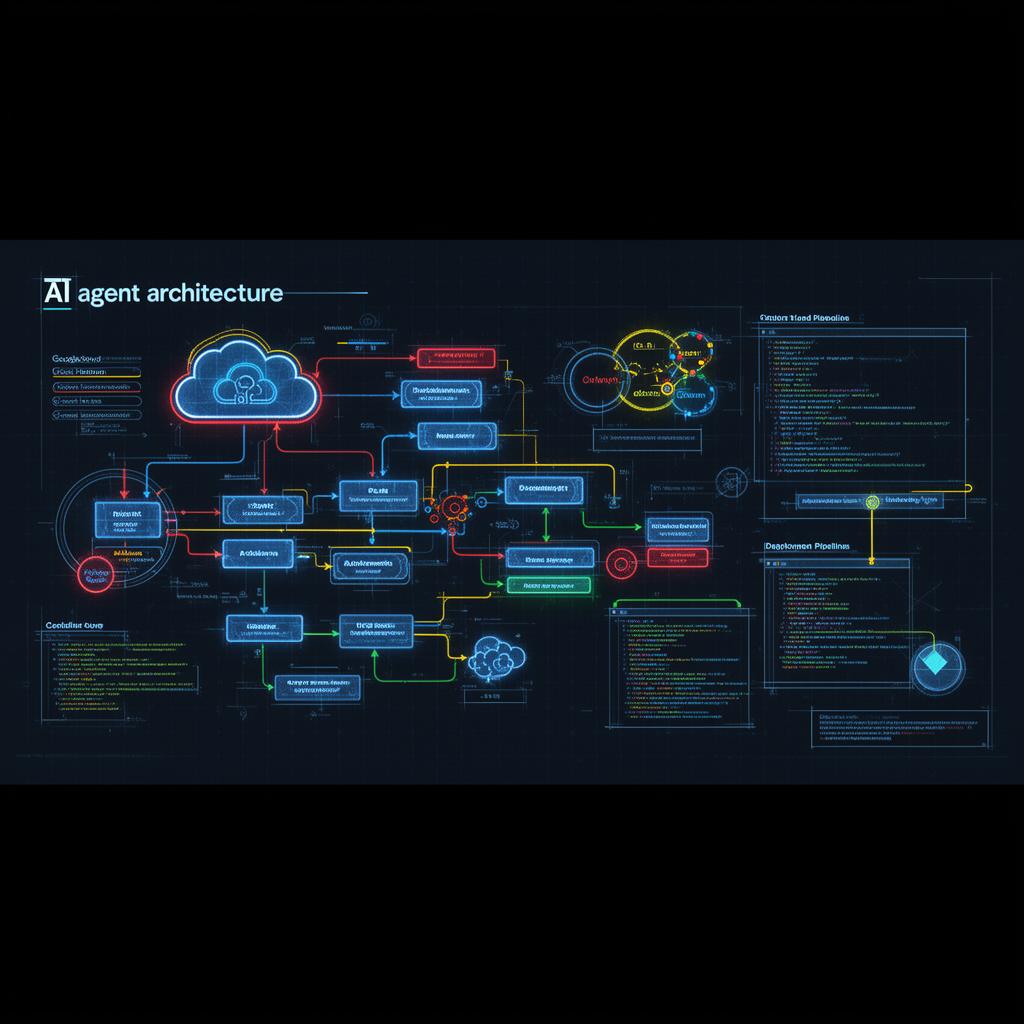
Building complex agentic workflows requires a thoughtful architectural approach. Here are key components and considerations:
1. Agent Definition and Roles
- Specialization: Each agent should have a clear, distinct role and set of capabilities (e.g., a "Data Analyst Agent," "Content Creator Agent," "Customer Support Agent").
- Tooling: Define the tools, APIs, and external systems each agent can access (e.g., database query tools, CRM APIs, email clients, search engines).
- Memory: Each agent needs its own context and memory. This can range from short-term context windows to long-term memory via vector databases.
- Prompt Engineering: Craft precise prompts that define the agent's persona, goal, constraints, and instructions.
Example Agent Definition (Conceptual):
    {
      "agent_name": "Research Analyst Agent",
      "role": "Gather and synthesize information from public sources.",
      "goal": "Provide a concise summary of market trends for a given product.",
      "tools": [
        "Google Search API",
        "Jira/Confluence (for documentation)",
        "Internal Knowledge Base API"
      ],
      "memory_type": "vector_database_for_past_research",
      "constraints": ["Cite all sources", "Focus on data from the last 12 months"]
    }
2. Workflow Orchestration Layer
This is the brain of your multi-agent system, responsible for coordinating the agents.
- Event-Driven Architecture: Agents emit events upon task completion, failure, or requiring input, triggering subsequent actions.
- State Management: Tracking the overall progress of the workflow, the status of each agent's task, and shared information.
- Task Queueing: Managing the order and execution of tasks, especially for agents that might operate asynchronously.
- Decision Engine: Determining which agent acts next, based on workflow rules, agent availability, and current state.
- Error Handling and Retry Logic: Mechanisms to detect failures, log them, and implement recovery strategies.
3. Communication Protocols
How do agents talk to each other and to the orchestrator?
- Standardized Message Formats: JSON or Protobuf for structured communication of data, status updates, and requests.
- Message Queues/Brokers: (e.g., Kafka, RabbitMQ, Google Cloud Pub/Sub) for asynchronous, decoupled communication.
- Shared Data Stores: A central database or object storage where agents can store and retrieve shared context or large data artifacts (e.g., Google Cloud Storage, PostgreSQL).
4. Tool Integration and APIs
Agents often need to interact with systems beyond the AI framework itself.
- API Wrappers: Standardized interfaces for agents to call external services (CRMs, ERPs, databases, web scraping tools).
- Sandboxing: For security and control, agents should operate within defined boundaries when interacting with external tools.
5. Human-in-the-Loop (HITL)
For critical decisions, compliance, or tasks requiring creativity, human intervention is crucial.
- Approval Gates: The workflow pauses, awaiting human review and approval before proceeding.
- Escalation Mechanisms: If an agent encounters an unresolvable issue, it can escalate to a human operator.
- Correction/Feedback: Humans can correct agent output or provide feedback to refine agent behavior.
6. Monitoring and Observability
Understanding what your agents are doing is paramount for debugging, optimization, and auditing.
- Logging: Comprehensive logs of agent actions, decisions, inputs, and outputs.
- Tracing: Tracking the execution path of a request across multiple agents and systems.
- Metrics: Performance indicators like task completion rates, latency, error rates, and resource utilization.
- Dashboards: Visualizing the health and performance of the entire agentic workflow.
Designing a Complex Agentic Workflow: A Practical Example
Let's consider a practical example: an automated "Customer Issue Resolution and Feature Suggestion" system for a SaaS company using a multi-agent approach.
Business Problem
Customers submit support tickets, but many require similar solutions, and often good feature ideas are buried within these tickets. The goal is to efficiently resolve common issues, summarize complex ones for human agents, and extract feature suggestions.
Agentic Workflow Blueprint
1. Workflow Trigger
- Event: New customer support ticket received via email or helpdesk system (e.g., Zendesk).
2. Orchestrator (Central Dispatcher)
- Receives new ticket event.
- Delegates the initial task (e.g., ticket classification) to a specialized "Ticket Triage Agent" via an initial prompt/message.
3. Ticket Triage Agent (LLM-based)
- Role: Classify ticket severity (High, Medium, Low), type (Bug, Feature Request, How-To, Data Inquiry), and identify keywords.
- Tools: Access to a knowledge base search API.
- Output: Classification, summary, and recommended next steps (e.g., "Route to Bug Agent," "Route to How-To Agent," "Extract Feature Idea").
- Communication: Sends classified ticket data back to the Orchestrator.
4. How-To Resolution Agent
- Role: Provide automated answers for common "how-to" questions.
- Trigger: Orchestrator routes "How-To" tickets.
- Tools: Access to comprehensive Product Documentation API, FAQ database.
- Logic: Attempts to find a definitive answer. If found, drafts an automated response to the customer. If not, escalates to a human support agent.
- HITL: If an answer isn't high confidence, sends a draft for human approval or re-routes to human.
- Output: Drafted email/response, or escalation message.
5. Bug Prioritization Agent
- Role: Analyze bug reports, check for duplicates, and estimate impact/priority.
- Trigger: Orchestrator routes "Bug" tickets.
- Tools: Access to Jira API (to check existing bugs), Sentry/error monitoring API (to verify reported errors), internal telemetry data.
- Logic: Searches Jira for duplicates. If duplicate, adds customer ticket to existing one. If new, analyzes severity, attempts to reproduce (via test environment API if low risk), and suggests priority.
- Output: Jira ticket ID, priority level, summary of bug, similar tickets identified.
- Communication: Updates Orchestrator, potentially creates a Jira ticket.
6. Feature Suggestion Agent
- Role: Extract, categorize, synthesize, and de-duplicate feature requests.
- Trigger: Orchestrator routes "Feature Request" classifications or if Triage Agent identifies one within another ticket type.
- Tools: Access to Notion/Confluence API (for a feature backlog database), internal product roadmap data.
- Logic: Extracts core feature idea, categorizes it, checks for similar existing suggestions, and adds it to a "Feature Backlog" with a summarized rationale.
- Output: New/updated feature entry in backlog, link.
7. Customer Communication Agent (Common Output)
- Role: Draft professional, personalized responses to customers based on outcomes from other agents.
- Trigger: Receives resolved status/content from How-To Agent or Bug Agent.
- Output: Final customer-facing email/message.
8. Monitoring and Logging
- Every agent action, decision, communication, and API call is logged to a central monitoring system (e.g., Google Cloud Logging, Cloud Monitoring with custom dashboards).
- Human review points are flagged for analysis.
Workflow Flow (Simplified)
- Customer submits ticket.
- Orchestrator receives event.
- Orchestrator sends ticket to Ticket Triage Agent.
- Ticket Triage Agent classifies (e.g., "How-To") and sends back to Orchestrator.
- Orchestrator routes to How-To Resolution Agent.
- How-To Resolution Agent finds solution, drafts response, and sends to Orchestrator.
- Orchestrator sends draft to Customer Communication Agent.
- Customer Communication Agent crafts final email, sends to human for optional review.
- Email sent to customer.
- (If failure at any step, Orchestrator escalates to human).
This sophisticated workflow automatically handles a significant portion of support requests, frees up human agents for truly complex issues, and systematically captures valuable product feedback.
Challenges and Best Practices
While the potential is immense, building such systems comes with challenges.
Challenges
- Orchestration Complexity: Managing state, concurrency, and dependencies across many agents is hard.
- Debugging and Transparency: "Why did the agent do that?" becomes harder with multiple interacting LLMs. Traceability is critical.
- Cost Management: LLM API calls can be expensive. Inefficient workflows or agents in infinite loops can quickly deplete budgets.
- Reliability and Resilience: LLMs can be non-deterministic. Building fault-tolerance into agent interactions is crucial.
- Security and Governance: Ensuring agents don't access unauthorized data or perform malicious actions.
- Prompt Engineering at Scale: Maintaining consistent behavior across many agents and prompts.
- Data Drift and Model Updates: Keeping agents relevant as underlying LLMs evolve or business data changes.
- Evaluation and Metrics: How do you measure the success of an entire workflow, not just individual agents?
Best Practices
- Start Small and Iterate: Begin with a single, well-defined agent, then gradually add complexity and introduce more agents.
- Clear Agent Roles: Each agent should have a distinct purpose, avoiding overlapping responsibilities unless intentional.
- Modular Design: Design agents as independent, interchangeable components. This aids testing and maintenance.
- Robust Error Handling: Implement comprehensive error handling, retry mechanisms, and human escalation paths.
- Comprehensive Observability: Invest heavily in logging, tracing, and monitoring to understand agent behavior and diagnose issues.
- Controlled Access to Tools: Implement strict authorization and sandboxing for agents accessing external systems.
- Define Communication Contracts: Establish clear input/output formats and expectations for inter-agent communication.
- Continuous Feedback Loops: Design the system to learn from human feedback and operational performance.
- Bias and Fairness Audits: Regularly assess the workflow for unintended biases or unfair outcomes.
- Cost-Aware Design: Optimize LLM calls, use cheaper models for simpler tasks if possible, and implement caching.
- Progressive Decentralization: While decentralized systems offer flexibility, start with a centralized orchestrator for control and predictability, then progressively explore more decentralized patterns as you gain confidence.
The Future of Agentic Workflows with WALT Labs
At WALT Labs, we believe that complex agentic workflows represent the future of enterprise automation and intelligent systems. Leveraging Google Cloud's robust AI infrastructure, including powerful LLMs like Gemini (accessible via Vertex AI), managed services like Cloud Functions, Cloud Workflows for orchestration, Pub/Sub for messaging, and advanced data analytics platforms like BigQuery, we empower businesses to design, build, and deploy these cutting-edge solutions.
Our expertise spans:
- Strategy & Design: Identifying high-impact use cases and architecting scalable agentic solutions.
- Development & Integration: Building custom agents, developing orchestration layers, and seamlessly integrating with existing enterprise systems.
- Deployment & Optimization: Deploying on Google Cloud, ensuring security, performance, and cost-efficiency.
- Monitoring & Governance: Implementing robust observability and governance frameworks for responsible AI.
Conclusion
Moving "beyond agentic AI" means embracing the collaborative power of multiple agents orchestrated into intelligent workflows. This approach unlocks unparalleled opportunities for automation, problem-solving, and innovation across diverse industries. While the journey presents architectural and operational challenges, the strategic advantages – from enhanced efficiency to deeper insights and superior customer experiences – are undeniable.
Are you ready to transform your business processes with the next generation of AI? Contact WALT Labs today to explore how complex agentic workflows can drive your organization forward.